I was introduced to just (JU) versus equal tuning (EQ) as a wind ensemble member in college. The idea was that an ensemble could adjust the width of their intervals to achieve a purer sound, the ensemble being free from the fixity of a keyboard layout.
Later in my career as an accompanist I found vocalists commonly coached to sing a “nice high seventh” or to “make that half step nice and small” from the fourth to the third. What could be causing so many vocalists to sing those harmonically important tones “out of tune?”
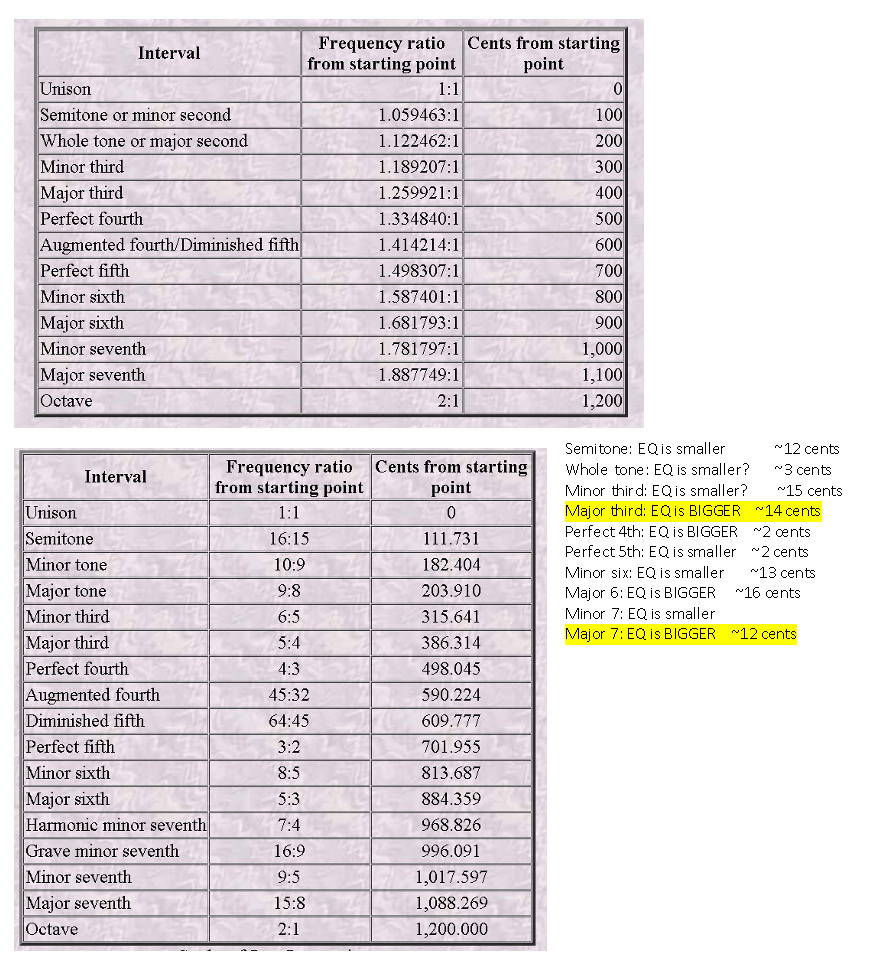
Using charts comparing equal temperament to just intonation, I argue that our pianos demand singers to modify their singing on tones we tend to focus on harmonically: the third and seventh. Intervals like the major third and seventh have a greater difference in cents than the perfect intervals when comparing between JU and EQ.
I won’t be able to argue (yet) that humans naturally sing in just intonation. There are cognitive and harmonic series items to consider to answer that question.
I will simply recognize that we focus on clean thirds and sevenths because they are more important than other scale members and they are especially wide on the piano.
Think in reference to tonic or discrete intervals?
So far I’ve been thinking in terms of a scale system where tones are relative to a tonic. I think this works with these charts because they reference a “starting point.”
But in EQ we could think of the fourth descending to a major third not only in terms of a “big” major third relative to the tonic, but as a “small” minor second between ^4 and ^3. This is potentially the equivalent information.
I could also argue that we implicitly reference tonic while singing the third in a chord, or the seventh leading tone etc. and it will always be better to think in a scale degree function sense rather than scientifically bare interval relationships.
How do we talk to vocalists about lowered mediants?
The EQ major and minor thirds are especially different compared to JU. The major is higher, and the minor is smaller. I think this makes us teach a certain way. In aural skills we generally tell students to sing Me and Le low. We are making sure they’re very clear on the minorizing of those– but we also do so to match the piano which makes those minor intervals smaller.
Other questions:
The JU system above has extra tones… can I find a chart where the JU system is used with 12 pitches? Would those match the cents given in the JU chart I already have? I now realize yes because the regular 12 tones are based on pure ratios– whether you include the quarter tones is of no consequence.
 uncollaborative piano
Leave a comment